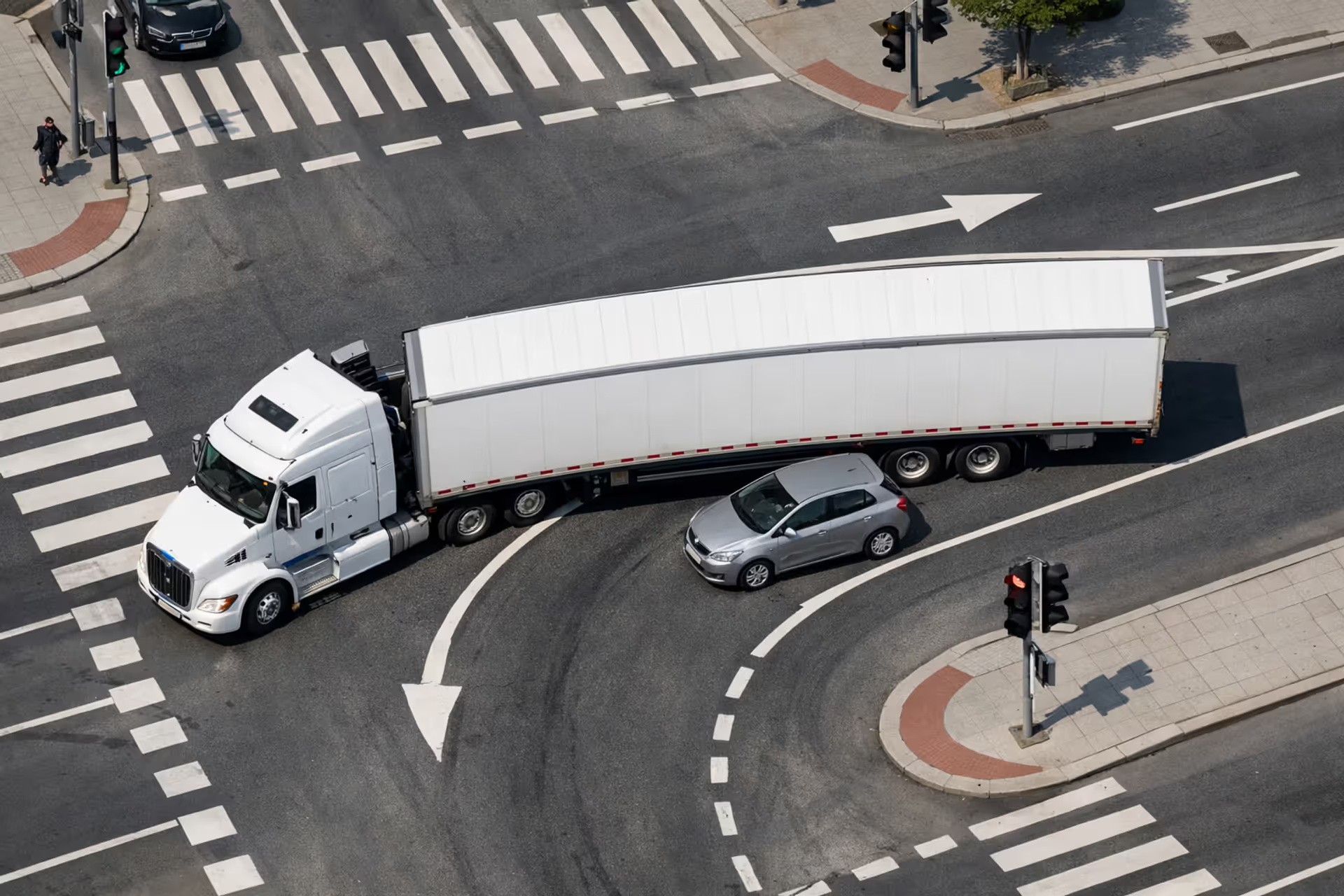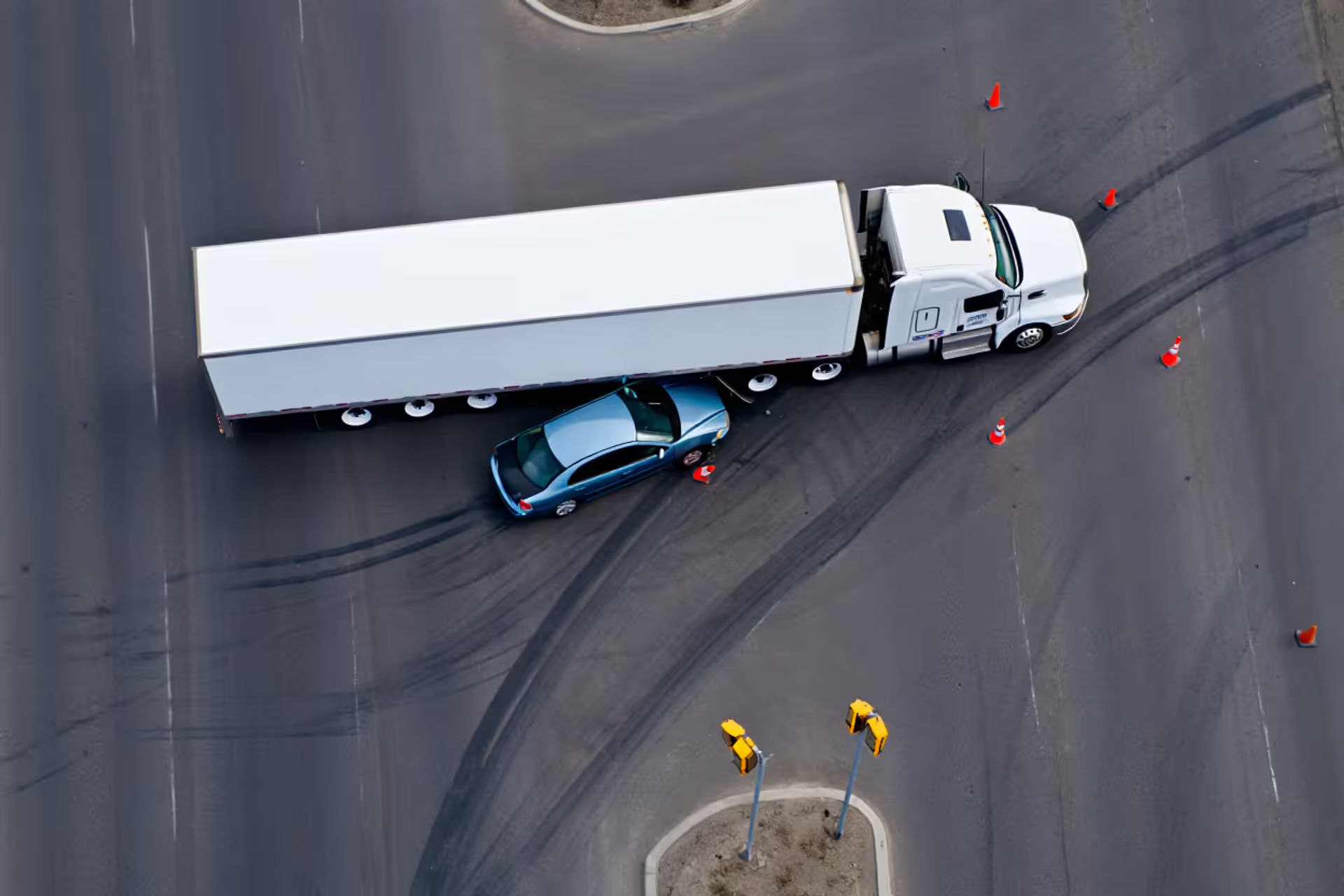
Aerial view of a highway accident scene showing a damaged silver sedan in front of a large white semi-trailer truck with skid marks on the road and orange traffic cones
Car vs Truck Accident: Why These Collisions Are Legally and Financially Different

Content
A collision between a passenger vehicle and a commercial truck creates consequences that bear little resemblance to typical traffic accidents. Consider the fundamental imbalance: a loaded semi-trailer weighs up to 40 tons, while your sedan tips the scales at roughly two. This dramatic weight difference represents just one of many factors that separate truck crashes from ordinary fender-benders.
These distinctions matter profoundly when you're dealing with insurance adjusters, medical bills, and potential legal action. The regulatory framework surrounding commercial vehicles, the web of potential defendants, and the compensation you might receive all change dramatically when an 18-wheeler is involved.
How Truck Accidents Differ From Regular Car Crashes
The contrast between passenger vehicle accidents and car-truck collisions extends across multiple dimensions that affect everything from your initial hospital visit to your final settlement check.
Size and Weight Disparities
Your Honda Accord weighs approximately 3,200 pounds. A Chevy Silverado comes in around 5,500 pounds when loaded. Meanwhile, a fully loaded tractor-trailer can legally weigh 40 tons—that's 80,000 pounds. Some overweight trucks illegally exceed even this threshold.
This mass imbalance creates collision dynamics that vehicle safety engineers struggle to address. When these vehicles meet at highway speeds, the lighter car absorbs the vast majority of destructive energy. Safety features calibrated for car-to-car impacts often fail catastrophically when a massive truck is involved. Underride collisions—where a smaller vehicle slides beneath a trailer—frequently result in roof removal and fatal head injuries.
Braking distances amplify the danger. Your passenger car needs approximately one football field to stop from 65 mph under ideal conditions. A commercial truck traveling the same speed requires nearly 600 feet—almost twice the distance. Add rain, poorly maintained brakes, or an exhausted driver, and stopping distances extend even further. This disparity explains why truck operators must maintain larger following distances and anticipate traffic changes much earlier than passenger vehicle drivers.
Injury Severity and Medical Costs
Trauma surgeons can often identify truck accident victims before reviewing the crash details. The injury patterns tell the story—the forces involved in these collisions produce distinctly different damage profiles.
Minor soft tissue injuries that would heal within weeks after a car accident frequently demand months of intensive treatment when a truck is involved. Simple fractures become complex breaks requiring surgical hardware. Mild concussions escalate into traumatic brain injuries with permanent cognitive deficits. Back injuries that might cause temporary discomfort in a minor crash can result in complete paralysis when the impact involves a commercial vehicle.
The financial impact of these injuries reflects their severity. A typical whiplash case from a car accident might accumulate $10,000 in medical expenses. The same injury type from a truck collision often exceeds $40,000 in treatment costs, involving extensive physical therapy, advanced imaging, and multiple specialists. Catastrophic injuries—complete spinal cord damage, traumatic amputations, third-degree burns—can generate lifetime medical costs exceeding several million dollars.
These elevated expenses directly shape settlement negotiations, but they also create immediate financial hardship for victims. Many health plans feature substantial deductibles or coinsurance provisions that leave injured people drowning in bills while their claim progresses through the legal system.
The severity of an injury is not measured solely by the wound itself, but by the life it permanently alters
— David Ball
Multiple Liable Parties in Trucking Collisions
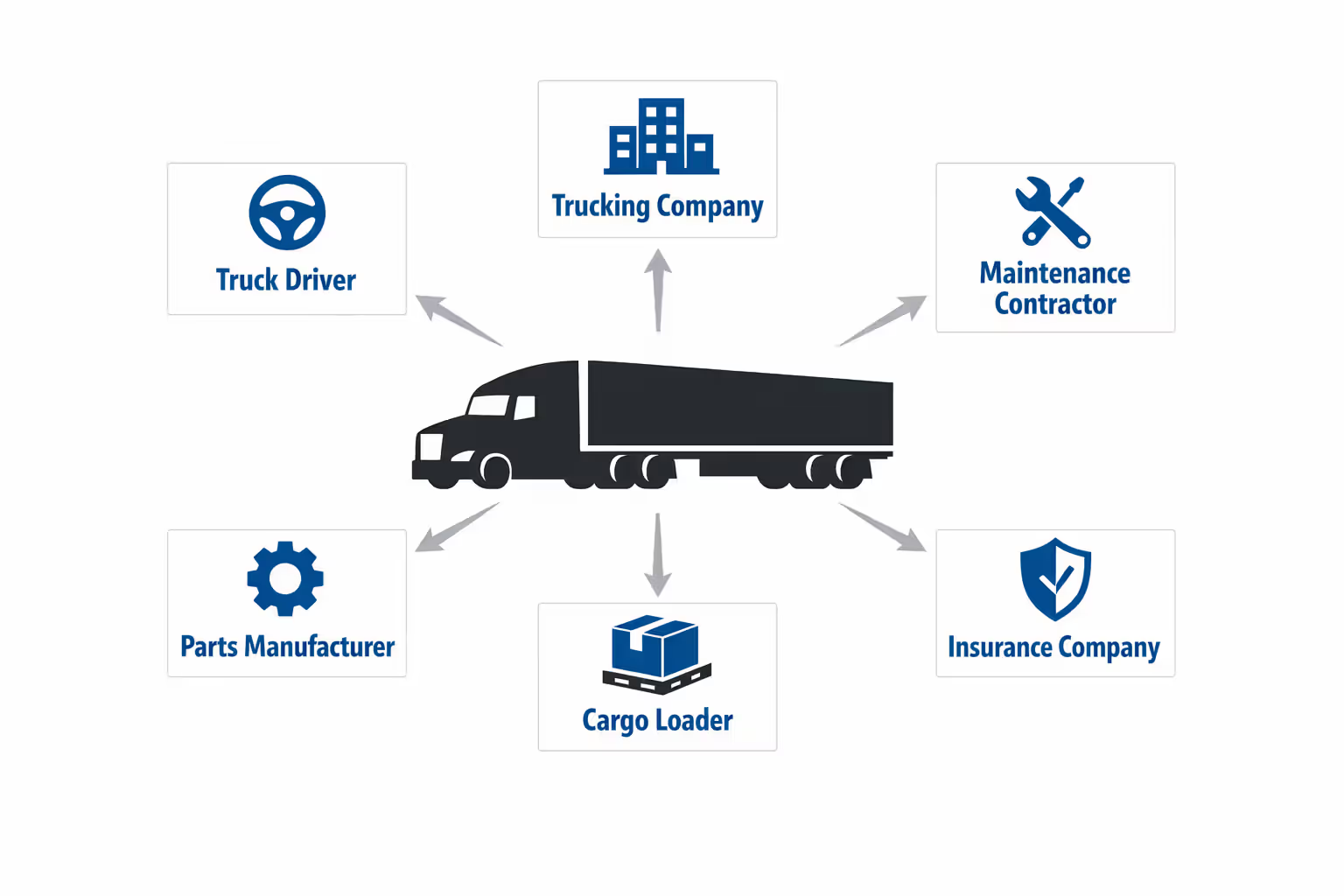
When you rear-end another sedan, liability typically involves one party: the at-fault driver. A commercial truck accident might implicate half a dozen defendants or more.
This expansion of potential liability stems from trucking's commercial nature. Drivers operate vehicles they don't own. Companies employ or contract these drivers, maintain the equipment, plan the routes, and impose delivery schedules that might pressure unsafe driving. Separate maintenance contractors may have performed inadequate brake service. Third-party cargo loaders could have improperly secured freight that shifted and caused the truck to overturn. Manufacturing defects in critical components can even bring parts suppliers into the liability picture.
Each potentially responsible party carries separate insurance coverage, retains its own legal team, and has strong incentives to redirect blame toward others. This complexity transforms even straightforward crashes into multi-defendant litigation requiring thorough investigation and sophisticated legal strategy.
Author: Rebecca Thornton;
Source: capeverde-vip.com
Who Can Be Held Responsible After a Car-Truck Collision
Establishing liability in commercial truck crashes demands examining everyone involved in putting that vehicle on the road and keeping it operational.
The truck driver faces personal liability for standard negligent behaviors: excessive speed, texting while driving, running stop signs, or operating under the influence. But commercial drivers must also follow federal Hours of Service regulations that limit consecutive driving time. A driver who falsifies electronic logs to exceed these limits creates liability through regulatory violations, regardless of whether fatigue directly contributed to the crash.
Trucking companies bear responsibility for their drivers' conduct under respondeat superior—the legal principle holding employers accountable for employee negligence during work activities. This responsibility reaches beyond the collision itself. Did the company properly vet the driver during the hiring process? Verify their driving history? Deliver adequate training? Companies that prioritize profit margins over safety protocols often face punitive damages beyond standard compensatory awards.
The employee versus independent contractor distinction adds complexity here. Many trucking companies label drivers as contractors to reduce liability exposure, but courts analyze the actual working relationship. When companies dictate routes, impose schedules, and control vehicle maintenance despite the "independent contractor" designation, they typically remain fully liable.
Maintenance contractors become defendants when mechanical defects contribute to crashes. A semi-truck accident attorney will carefully examine service records, searching for postponed inspections, inadequate repairs, or ignored safety defects. Failed brakes, tire blowouts, and steering system malfunctions frequently originate from insufficient maintenance, establishing liability for the service providers responsible for commercial vehicle safety.
Parts manufacturers face strict product liability claims when defective components cause collisions. Tire companies have paid substantial damages for tread separation defects. Brake manufacturers answer for hydraulic system failures. These claims operate under strict liability doctrine—you needn't prove the manufacturer was careless, only that a defect existed and contributed to the crash.
Cargo loaders might appear tangential, but improper load securement causes thousands of truck accidents annually. Shifting cargo destabilizes vehicles, increasing rollover risk. Overweight trucks exceed safe braking capacity and overstress tires and suspension systems. When cargo problems contribute to a commercial truck crash, loading companies share legal responsibility.

Author: Rebecca Thornton;
Source: capeverde-vip.com
What Affects Truck Crash Settlement Amounts
Settlement values in truck accidents reflect both the severity of harm and the difficulty of establishing liability against well-resourced corporate defendants.
These ranges represent documented case outcomes, though individual circumstances produce significant variation. Multiple factors push settlements toward the upper boundaries of these ranges.
Policy limits establish the practical maximum for many claims. While passenger vehicles typically maintain $25,000 to $100,000 in liability insurance, commercial trucks must carry minimum coverage between $750,000 and $5,000,000 depending on cargo classification and gross vehicle weight. These higher coverage requirements make substantial settlements financially feasible.
Compelling liability evidence strengthens your negotiating leverage. Truck accidents create extensive documentation: electronic logging device records revealing hours-of-service violations, event data recorder information capturing speed and brake application, maintenance logs exposing skipped safety inspections, and video recordings showing the collision sequence. Strong evidence pressures insurers toward reasonable offers rather than risking jury verdicts.
Lasting impairment substantially increases claim value. Temporary injuries resolve; permanent ones demand lifetime compensation. A 35-year-old who becomes paraplegic faces four decades of adapted housing expenses, ongoing medical care, and eliminated income potential. Life care planners and economists calculate these lifetime costs, generating settlement demands reaching into the millions for catastrophic injuries.
Punitive damages enter consideration when defendants demonstrated reckless disregard or intentional misconduct. A trucking company that knowingly operated vehicles with critical safety defects, or a driver caught operating while intoxicated, might face punitive awards designed to punish wrongdoing and prevent future violations. These damages can multiply standard compensatory awards by factors of three, five, or even ten.
Cases involving commercial vehicles present fundamentally different challenges than standard automobile accidents. You're confronting corporate defendants with experienced legal teams whose entire profit model depends on minimizing claim payouts. Without equally skilled representation, injured victims routinely accept settlements worth a fraction of their claim's true value.
— Michael Thompson
Comparative negligence diminishes settlements when victims bear partial fault. If you were checking your phone when the truck failed to yield, a jury might allocate you 30% responsibility, reducing your award accordingly. Defense attorneys exploit any evidence of shared fault to decrease settlement offers.
| Injury Type | Car Accident Settlement Range | Truck Accident Settlement Range | Key Factors |
| Soft tissue injuries | $3,000 - $25,000 | $15,000 - $75,000 | Length of treatment, chronic pain issues, effect on work and daily life |
| Broken bones | $15,000 - $75,000 | $50,000 - $250,000 | Fracture count, need for surgery, permanent metal implants, rehabilitation duration |
| Spinal injuries | $50,000 - $500,000 | $250,000 - $2,500,000+ | Paralysis extent, long-term care requirements, future earning capacity loss |
| Traumatic brain injury | $100,000 - $1,000,000+ | $500,000 - $5,000,000+ | Cognitive damage severity, personality alterations, capacity to maintain employment |
| Fatalities | $250,000 - $1,000,000 | $1,000,000 - $10,000,000+ | Deceased's age and income, dependent count, negligence severity |
Common Mistakes That Hurt Your Truck Accident Claim
Even powerful cases lose significant value when victims make avoidable missteps during the weeks following a collision.
Postponing medical evaluation represents the most damaging error. Adrenaline and shock mask pain immediately after crashes. Victims who feel "acceptable" at the scene often refuse ambulance transport, only to develop severe symptoms within days. Defense attorneys interpret delayed treatment as proof of minor injuries, contending that genuine trauma would have prompted immediate medical attention. Get examined within 24 hours of any truck collision, regardless of how you feel.
Giving recorded statements to insurance adjusters without attorney guidance creates weapons they'll use against you. Adjusters project sympathy while posing seemingly harmless questions specifically designed to elicit damaging responses. "You're doing better now, correct?" transforms into evidence of full recovery. "You never saw the truck approaching?" suggests inattentiveness on your part. Respectfully decline all recorded statements until you've consulted a trucking accident lawyer.
Taking early settlement offers before understanding your injury's full scope trades long-term financial security for immediate cash. Trucking companies understand that premature offers—extended while victims struggle with mounting medical bills and lost paychecks—create powerful temptation. But minor tissue damage can evolve into chronic pain syndromes. Seemingly mild head trauma can manifest lasting cognitive problems that don't fully appear for many months. After signing a settlement release, you cannot reopen the claim when complications emerge.
Publishing on social media supplies defense lawyers with misleading ammunition. A photograph showing you smiling at a cousin's wedding becomes "proof" you're exaggerating your suffering. Your gym check-in suggests your reported back injury lacks severity, despite your physician recommending gentle activity. Set all social media accounts to maximum privacy and avoid posting anything related to your accident, injuries, or daily activities until your claim concludes.
Neglecting scene documentation allows critical evidence to vanish. If you're physically capable, photograph all vehicle damage from numerous angles, tire marks, traffic control devices, weather conditions, and truck identification details (company name, DOT registration number, license plate). Obtain contact details from witnesses before they depart. This documentation becomes invaluable when the trucking company's narrative contradicts your account.
Injustice anywhere is a threat to justice everywhere. We are caught in an inescapable network of mutuality
— Martin Luther King Jr.
Missing statutory filing deadlines destroys otherwise valid claims. Most jurisdictions impose two-to-four-year deadlines for initiating personal injury lawsuits, though some allow merely one year. These deadlines are absolute—missing them by even 24 hours eliminates all rights to compensation, no matter how compelling your case. Consult an attorney promptly to guarantee compliance with all relevant deadlines and to secure evidence before it disappears.
Pursuing the claim alone might suffice for minor parking lot incidents, but truck accidents demand specialized expertise. These cases involve federal motor carrier safety regulations, complicated corporate ownership structures, and insurance policies featuring multiple coverage layers. General practice attorneys lack the focused knowledge required to maximize truck crash settlements.
When You Need a Specialized Trucking Accident Attorney
While not every accident warrants legal representation, car-truck collisions almost invariably do. The real question becomes when to hire counsel and what type of expertise to seek.
Federal trucking regulations alone justify specialized representation. The Federal Motor Carrier Safety Regulations span hundreds of pages detailing requirements for driver qualifications, vehicle maintenance schedules, cargo securement methods, hours-of-service limitations, and mandatory drug testing protocols. Violations of these regulations establish negligence per se in most states—meaning the violation itself proves negligence without requiring additional proof. However, you must identify which regulations apply and know how to access evidence of violations.
A specialized semi-truck accident attorney commands resources that general personal injury practitioners cannot provide. Truck accident reconstruction demands engineers who understand commercial vehicle physics, air brake systems, and jackknife mechanics. Trucking company operations analysis requires familiarity with electronic logging systems, dispatch software, and maintenance record interpretation. These experts charge substantial fees, and most general practice firms cannot afford to front these costs across multiple cases.
Seek attorneys who dedicate a significant portion of their practice to truck accidents, not those who handle them occasionally among diverse personal injury cases. Ask pointed questions: How many truck accident cases have you resolved in the last 24 months? What percentage of your caseload involves commercial vehicles? Can you provide references from trucking industry experts you've worked with previously? Have you taken cases to verdict against major trucking companies, or do you settle everything before filing suit?
Trial experience matters substantially more in trucking litigation than typical car accidents. Trucking companies and their insurers recognize which attorneys actually try cases versus those who capitulate under pressure. An attorney with documented courtroom victories commands respect during settlement discussions, frequently securing superior offers without needing to file a lawsuit.
Timing impacts attorney selection significantly. Ideally, consult a trucking accident lawyer within 72 hours of the collision, before critical evidence vanishes. Trucking companies must preserve certain records only after receiving formal spoliation letters—legal demands to maintain evidence. Without these preservation demands, companies might legally destroy maintenance records, driver logs, and electronic data after their standard retention schedules expire.
Contingency fee structures make specialized representation accessible regardless of your current financial situation. Most truck accident attorneys work on contingency, collecting a percentage (usually 33-40%) of any settlement or jury award. You pay nothing upfront and owe nothing unless you recover compensation. This arrangement aligns attorney financial incentives perfectly with yours—they profit only when you do.

Author: Rebecca Thornton;
Source: capeverde-vip.com
How Long Do Truck Injury Claims Take to Resolve
Understanding realistic timelines helps you plan financially and emotionally for the process ahead. Truck accident claims typically require more time than car-only accidents, though specific circumstances create wide variation.
Minor injury claims with obvious liability might resolve within three to six months. You finish treatment, your attorney submits a compensation demand, and the insurer extends a reasonable offer that you accept. These rapid resolutions require several conditions: indisputable truck driver fault, injuries that completely resolve, and an insurer willing to negotiate in good faith.
Moderate injury claims involving some liability dispute typically need six to eighteen months. You might reach maximum medical improvement after several months of care, but the trucking company challenges fault or contends you share responsibility. Your attorney must compile evidence, potentially hire expert witnesses, and negotiate through several rounds of offers and counteroffers. Many cases settle during this window, often after your attorney initiates litigation but before extensive discovery proceedings.
Severe injury claims often consume two to four years, particularly when they proceed to jury trial. Catastrophic injuries require extended treatment before reaching maximum medical improvement—the point where physicians can reliably assess permanent impairment. You cannot accurately value a claim until doctors determine whether you'll regain mobility, return to your occupation, or need lifelong assistance. Complex liability questions, multiple defendants, and substantial damages all motivate trucking companies to fight longer and harder.
Several factors speed resolution. Overwhelming evidence of truck driver or company negligence makes liability nearly impossible to contest. Comprehensive medical documentation establishing your injuries and necessary treatment eliminates causation disputes. Realistic settlement demands grounded in provable damages encourage productive negotiation. Motivated defendants facing devastating evidence frequently settle quickly to avoid trial publicity and expense.
Other factors create delays. Contested liability demands extensive investigation, witness depositions, and potentially accident reconstruction analysis. Continuing medical care prevents claim resolution until you reach maximum medical improvement—you cannot settle before understanding your injury's full extent. Multiple defendants each attempting to minimize their liability share prolongs litigation as they point fingers at one another. Insufficient insurance coverage sometimes forces you to pursue excess policies or even defendant personal assets, complicating the collection process.
The claims process follows a predictable sequence. Immediately following the accident, prioritize medical treatment and evidence collection. During the initial months, your attorney investigates liability, assembles records, and identifies all potential defendants. Once you complete treatment, your attorney submits a compensation demand, typically including a comprehensive package documenting injuries, medical care, income loss, and additional damages.
Negotiations might continue for weeks or months. If settlement discussions fail, your attorney initiates a lawsuit, beginning the discovery phase where both parties exchange documents, conduct depositions, and retain expert witnesses. Many cases settle during discovery as evidence strength becomes apparent. Cases that survive discovery proceed to mediation—a structured settlement conference facilitated by a neutral mediator—where the majority of remaining cases resolve. Only a small fraction actually proceed to jury trial.
Understanding this timeline helps set expectations. Don't anticipate quick resolution of serious truck accident claims. Maintain emergency savings if possible, or explore litigation funding alternatives with your attorney. Patience frequently pays dividends—rushing to settle before fully understanding your injuries and long-term prognosis typically leaves substantial compensation unclaimed.
Frequently Asked Questions About Car vs Truck Accidents
The distinctions between car accidents and truck accidents penetrate every aspect of the legal and financial aftermath. Greater mass generates more severe trauma. Commercial operations introduce numerous potentially liable parties. Federal safety regulations add procedural complexity. Higher insurance coverage limits enable larger settlements. These factors combine to transform what might appear to be a straightforward injury claim into a sophisticated legal matter demanding specialized knowledge.
If you've suffered injuries in a collision involving a commercial truck, three actions safeguard your interests: obtain immediate medical evaluation even if symptoms seem minor, refuse to provide statements to trucking company insurers before consulting legal counsel, and contact a specialized trucking accident lawyer within 72 hours of the crash. Critical evidence vanishes rapidly—electronic data gets overwritten on routine schedules, witnesses' memories fade, and physical evidence at the scene gets cleared away.
The financial stakes in truck accident cases warrant taking these claims seriously from the beginning. The difference between handling the claim independently and retaining experienced truck injury legal advice frequently measures in tens or hundreds of thousands of dollars. Trucking companies and their insurers deploy sophisticated tactics to minimize claim payouts. Countering their resources and expertise demands representation from attorneys who understand the distinctive challenges these cases present.
Your primary focus should remain on medical recovery while your legal team addresses the complexities of establishing liability, documenting all damages, and negotiating appropriate compensation. Understanding the fundamental differences between truck accidents and typical car crashes empowers you to make informed decisions about your claim and recognize when you need specialized assistance navigating this demanding process.