
Courtroom interior with legal documents on plaintiff table and financial data displayed on screen, semi-truck visible through window
Punitive Damages in Trucking Cases: When Courts Award Jury Punishment Beyond Compensation

Content
Here's what most people don't realize about serious truck crashes: the check covering your medical bills and lost paychecks? That's just the beginning. When trucking companies deliberately ignore safety rules, falsify records, or force drivers into dangerous situations, courts can authorize an entirely separate category of financial penalties. These damages don't reimburse anything you lost—they exist purely to punish corporate wrongdoing and send a message to the entire industry.
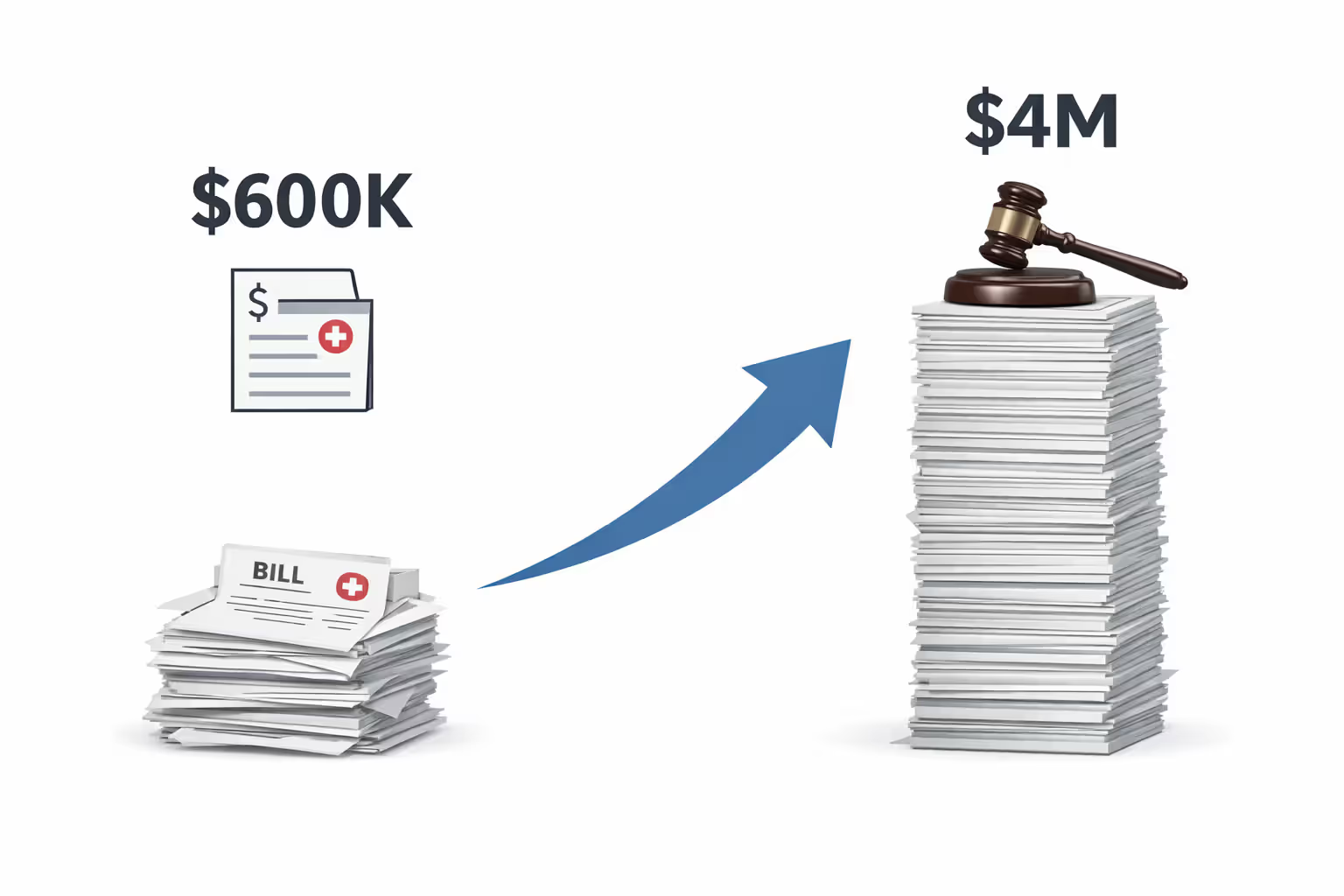
The financial gap between these two types of awards can be staggering. I've seen cases settle for $600,000 in medical costs and lost earnings, then multiply to $4 million after a jury learned the company had been systematically violating federal safety regulations for years.
What Separates Punitive Damages from Compensatory Awards in Truck Accident Claims
Think of compensatory damages as repayment. Your hospital charged $180,000 for trauma surgery? The defendant pays $180,000. You'll miss nine months of work worth $45,000 in salary? Add $45,000. Chronic back pain affects your quality of life? Juries assign a dollar value to that suffering. The goal is restoration—putting a dollar figure on everything the crash took from you.
Punitive awards operate on completely different logic. They're not calculating what you lost. They're asking: "What will hurt this company enough to stop this behavior?" The victim receives the money, but that's almost incidental. Courts really aim these penalties at the boardroom, not the hospital room.
Juries can only impose punishment when defendants cross certain bright lines. We're talking about malice—actual intent to harm. Fraud—deliberate deception about safety. Oppression—willful despising of someone's rights. Or my area of focus: reckless disregard for human safety. The defendant must know their conduct creates serious danger and just not care.
Author: Marcus Delaney;
Source: capeverde-vip.com
That's why fewer than 5% of truck accident verdicts include these awards. Most crashes result from ordinary mistakes—misjudged distances, momentary inattention, standard human error. Those cases recover full compensation but trigger no additional punishment. The legal system saves that hammer for conduct that disgusts reasonable people.
Consider this distinction: A driver checks their mirror, thinks the lane is clear, changes lanes anyway, and clips your vehicle. Negligence? Absolutely. Punishable beyond compensation? No. Now imagine a company whose executives received three warnings from their safety director about critically defective brakes on fifteen trucks, then replied via email: "Repairs cost $8,000 per truck. Average lawsuit settles for $120,000. We've got 15 trucks, so worst case we're looking at one or two crashes. That's $240,000 max exposure versus $120,000 in repairs. Keep them rolling." That email gets projected on a screen in court, and suddenly you're in punitive territory.
The purpose of punitive damages is not to compensate the plaintiff for any loss, but to punish the defendant for outrageous conduct and to deter the defendant and others like it from similar conduct in the future. When a corporation treats human safety as a line item on a balance sheet, the civil justice system must respond with consequences that reach the boardroom.
— Victor E. Schwartz
The Burden of Proof Required for Punitive Awards
Standard injury cases require a "preponderance of evidence"—legal speak for "probably happened." If the evidence makes something seem 51% likely, you've met your burden. It's the lowest proof standard in civil court because we're just moving money around between private parties.
Punitive damages require "clear and convincing evidence" in most jurisdictions—roughly 70-75% certainty. You're not just proving the crash happened or that someone acted carelessly. You're proving they acted so badly they deserve financial punishment, which raises constitutional concerns about due process.
This higher bar means you need documentation, not theories. Helpful evidence includes: - Email chains where executives discuss ignoring safety violations - Multiple inspection reports showing the same critical defects going unfixed - Testimony from former employees about unwritten policies to falsify records - Financial analyses showing the company budgeted for lawsuits rather than compliance
"We think they probably knew" won't cut it. You need the smoking gun—preferably in the form of a spreadsheet or memo that explicitly weighs profits against human life.
Five Types of Trucking Company Conduct That Trigger Punitive Damages
Certain corporate behaviors almost guarantee punitive exposure if you can document them. These aren't random accidents—they're policy choices.
Maintaining dual logbook systems ranks as perhaps the clearest example. Federal law requires drivers to log their hours to prevent fatigue-related crashes. When companies tell drivers to keep two sets of books—one showing legal hours for inspectors, one showing actual hours worked—that's premeditated fraud. A 2019 Georgia jury awarded $15 million in punitive damages after discovering a carrier ran this exact scheme, with drivers routinely working 14-15 hour days while official logs showed perfect compliance. The company hadn't just failed to prevent violations; it had created an entire system to commit and hide them.
Deferring repairs on documented safety defects becomes actionable when you can prove knowledge plus inaction. Every fleet has maintenance issues—that's normal. The punitive trigger is when mechanics write up critical problems in official inspection reports, management reviews those reports, and trucks get sent back out anyway. Florida case example: internal emails revealed a fleet manager acknowledging "Unit 47 has brake failure—can't stop safely from highway speeds," followed by "but Q4 numbers are tight, keep it in rotation." That truck's brakes failed three weeks later on I-95, killing two people. The subsequent verdict included $8.7 million in punitive damages.

Author: Marcus Delaney;
Source: capeverde-vip.com
Background check failures cross into punishment territory when they're not oversights but deliberate policy. Federal Motor Carrier Safety Regulations require checking driving records, criminal histories, and previous employment. Some companies treat this as a suggestion rather than a mandate. One Kansas carrier hired 23 drivers over 18 months without conducting a single MVR check—faster hiring process, they explained. When one of those drivers (with three prior DUI convictions) caused a fatal crash while intoxicated, the company faced corporate liability damages of $12 million. The company hadn't made a mistake; they'd implemented a policy of not checking.
Delivery schedules that require illegal hours create clear corporate culpability. Here's how it works: dispatch assigns a load from Los Angeles to Chicago with a 36-hour delivery window. That route requires 32 hours of driving time, leaving only four hours for fuel stops, inspections, and rest. Federal law mandates 11 hours driving maximum per 14-hour shift, with 10 hours off-duty between shifts. The schedule makes compliance mathematically impossible. When the driver gets caught exceeding hours—or crashes due to fatigue—text messages from dispatch saying "I don't care how you make it work, that load delivers by Thursday morning or you're fired" become Exhibit A in punitive damages arguments.
Running trucks with out-of-service violations demonstrates the willful disregard courts target. Roadside inspections sometimes identify defects serious enough that inspectors mark vehicles "out of service"—legally prohibited from operation until repairs are completed and documented. Some companies simply relocate those trucks to states with lower inspection rates and keep running them. One national carrier got caught moving 47 trucks flagged out-of-service in California to routes through Nevada and Arizona. When one of those trucks—specifically cited for steering defects—lost control and crossed the median, killing four people, the jury heard about all 47 trucks. The verdict included $23 million in punitive damages.
Thomas Petersen, who's represented catastrophic injury victims in trucking litigation for 23 years, puts it this way: "I've handled probably 200 serious truck crash cases. The ones where juries award punitive damages share one characteristic: we find evidence that corporate decision-makers ran a cost-benefit analysis. They literally calculated the potential liability from crashes against the cost of fixing the problem and chose the cheaper option. When you show a jury the spreadsheet where executives decided that your family member's life was worth less than $8,000 in brake repairs, that's when the punitive awards get serious."
How Gross Negligence and Reckless Driving Differ in Trucking Litigation
The distinction between ordinary negligence, gross negligence, and reckless conduct determines whether punitive damages are even on the table. Understanding these categories matters because your case value might differ by millions depending on which applies.
| Legal Standard | What It Means | Evidence Level Needed | Trucking Example | Can You Get Punitive Damages? |
| Ordinary Negligence | Standard carelessness; a lapse in attention or judgment that breaches duty of care | Preponderance (more likely than not—roughly 51% certainty) | Trucker misjudges following distance in rain and rear-ends stopped traffic | No—only compensatory awards available |
| Gross Negligence | Severe departure from what reasonable person would do; extreme carelessness showing conscious indifference | Clear and convincing evidence (approximately 70-75% certainty) | Driver texts continuously for 35 minutes while going 75 mph through construction zone, ignoring three near-collisions | Yes in most states—conduct shows extreme disregard |
| Reckless/Willful Misconduct | Knowingly creating substantial risk of serious harm; acting with actual awareness of danger | Clear and convincing evidence (approximately 70-75% certainty) | Driver takes methamphetamine before starting 11-hour shift, knowing it impairs judgment, or company orders removal of collision avoidance equipment | Yes—strongest case for substantial punitive awards |
Most traffic collisions involve ordinary negligence. The driver got distracted by their GPS and drifted into your lane. They thought they had time to make the yellow light but misjudged. Their attention lapsed for three seconds at the wrong moment. These are the standard human failures that cause most accidents. Victims recover complete compensation for medical bills, lost income, pain and suffering—but nothing beyond that. The law sees these as mistakes, not misconduct deserving punishment.
Gross negligence trucking cases involve behavior so careless it practically ignores safety entirely. Picture a commercial truck driver watching a movie on their phone, mounted on the dashboard, eyes off the road for 30-45 seconds at a time while driving 70 mph. They know this is wildly unsafe—everyone knows looking at screens instead of the road causes crashes. But they do it anyway, repeatedly, over miles of highway. That crosses from "made a mistake" into "didn't care about the obvious danger." The conscious choice to proceed despite known risk—that's the distinguishing factor.
Reckless conduct sits at the top of the culpability ladder. This involves actual knowledge of substantial danger combined with deliberate choice to create or ignore it. Driver who physically removes their electronic logging device to hide hours-of-service violations, then drives 19 straight hours while struggling to stay awake? That's reckless. Company that learns drivers are disabling lane departure warnings because the alerts are "annoying" and does nothing? Reckless. The person or company knows they're creating serious danger and actively chooses to proceed or allow it.
The practical impact on your case: ordinary negligence suits settle based on medical bills and lost earnings calculations. Gross negligence cases may add punitive damages worth two to four times your compensatory award. Reckless conduct cases can generate punitive damages worth five to ten times the compensatory amount—occasionally higher when the defendant is a large corporation and the behavior particularly shocks the conscience.
Understanding these distinctions matters during settlement negotiations. Defense attorneys often argue "this was just negligence, not gross negligence" because they know reclassifying conduct down one category removes millions in exposure. You need evidence establishing which category applies—and an attorney who knows how to present that evidence effectively.

Author: Marcus Delaney;
Source: capeverde-vip.com
Corporate Liability: When Trucking Companies Pay Punitive Damages for Driver Actions
Respondeat superior—a Latin phrase meaning "let the master answer"—holds employers responsible when employees cause harm during work. If a truck driver runs a red light while making deliveries, the trucking company pays for resulting injuries even when management did nothing wrong personally. That's standard vicarious liability.
Punitive damages work differently. Courts won't automatically punish companies just because an employee did something terrible. The company itself needs to have done something punishable, or its policies need to have encouraged or enabled the harmful conduct.
Three main paths establish corporate punitive liability:
Company policies that directly create danger: When corporate rules or incentive structures push employees toward risky behavior, the company faces direct liability. Example: A carrier implements a compensation plan where drivers earn bonuses based on fastest delivery times, with the top 10% earning an extra $15,000 annually. Management knows this creates pressure to speed and skip required rest breaks. That's not an employee going rogue—that's a corporate policy incentivizing the dangerous behavior. The company can't later claim "we just told him to deliver on time, not to break laws getting there." The policy itself deserves punishment.
Failures in hiring, training, or supervision: When companies skip required safety checks during hiring, provide inadequate training, or ignore documented safety violations by existing employees, those failures create independent corporate liability. Real case: A carrier hired a driver who had five moving violations and two preventable accidents in the previous three years—disqualifying factors under federal regulations. The company never reviewed his MVR because "the hiring manager was behind on applications." That driver caused a fatal crash six weeks later. The company's hiring failure—separate from the driver's negligence—supported punitive damages.
Ratification after learning of misconduct: Even when a company didn't initially know about dangerous conduct, it can become liable for punitive damages by doing nothing after discovering it. Example: A safety manager learns through ELD audits that a particular driver has exceeded hours-of-service limits 12 times in two months. Instead of disciplining or retraining the driver, the company takes no action. Three months later, that driver crashes while fatigued after another hours violation. The company's decision to ignore the pattern—once they knew about it—ratifies the dangerous behavior. Some courts find ratification when companies defend obviously dangerous driver actions in litigation rather than acknowledging the conduct was wrong.
The critical concept: punitive damages target decision-makers whose choices created systematic danger. One driver acting alone, against company policy and training, rarely creates corporate punitive exposure. A company culture where meeting delivery schedules matters more than safety compliance—that creates massive exposure.
Legal standards for punitive damages require showing that management-level employees—directors, vice presidents, operations managers—knew about dangerous practices and either created or tolerated them. Discovery focuses on communications between executives, operations directors, and safety personnel. The most damaging evidence? Emails discussing safety as a cost factor rather than a priority. "Compliance costs us $400K annually in downtime" or "we're losing competitive edge because other carriers aren't following these rules as strictly" or "the fine for a violation is only $5,000 but fixing the problem costs $15,000"—these kinds of corporate communications show the callous indifference courts punish through punitive awards.

Author: Marcus Delaney;
Source: capeverde-vip.com
What Determines Punitive Damage Amounts in Trucking Verdicts
After a jury decides punishment is warranted, they must determine the dollar amount. Unlike compensatory damages with relatively clear calculation methods (medical bills plus lost wages plus estimated pain value), jury punishment awards involve considerable discretion—though not unlimited discretion.
How bad was the conduct? This factor matters most. Courts examine whether the defendant showed mere indifference or actively concealed dangers. A company that ignored one safety violation differs dramatically from one that destroyed maintenance records, threatened employees who raised concerns, and lied to federal investigators. The more intentional the harm, the larger the multiplier. Conduct involving deception or cover-up particularly inflames juries.
Proportionality to compensatory damages: The U.S. Supreme Court suggested (though didn't mandate) that punitive awards exceeding 9:1 ratios to compensatory damages may violate due process protections. Most courts treat 4:1 as presumptively reasonable. A case with $2 million in compensatory damages might support $8 million in punitive damages without raising constitutional red flags. Higher ratios—10:1 or 15:1—require exceptional circumstances, typically involving particularly egregious conduct with relatively modest compensatory damages (maybe a victim died quickly, limiting pain and suffering damages, even though the corporate conduct was horrific).
Financial resources of the defendant: A $400,000 penalty might bankrupt a five-truck operation but mean nothing to a national carrier generating $3 billion in annual revenue. The punishment must hurt enough to actually punish. Courts allow evidence of corporate net worth, annual revenue, and profitability so juries can calibrate awards that accomplish their deterrent purpose. Discovery produces tax returns, financial statements, and expert testimony about what dollar amount would actually impact corporate decision-making.
Comparable penalties for similar violations: Juries may consider what federal or state regulators could fine for comparable violations. FMCSA regulations authorize penalties up to $25,000 per violation for certain safety failures. If the company committed 200 hours-of-service violations over two years, that establishes a baseline: regulators could have imposed $5 million in fines. That context helps juries understand appropriate punishment levels.
Potential harm versus actual harm: Courts distinguish between the harm that occurred and the potential harm the conduct risked. A driver under the influence might have killed one person but endangered everyone on a five-mile stretch of highway. Corporate policies eliminating brake inspections might have caused one crash but created danger for thousands of motorists over months. Juries can consider this broader risk when setting appropriate deterrent amounts—they're not just punishing the actual harm but the recklessness of gambling with many lives.
State-imposed caps: Many states limit punitive damages regardless of what juries award, which dramatically affects case value calculations.
State-by-State Variations in Punitive Damage Laws for Commercial Trucking
Where your case gets filed matters enormously. Geography can literally determine whether punitive damages are possible and, if so, how much you might recover. Jurisdiction—usually determined by accident location or defendant's headquarters—can mean the difference between maximum recovery and zero.
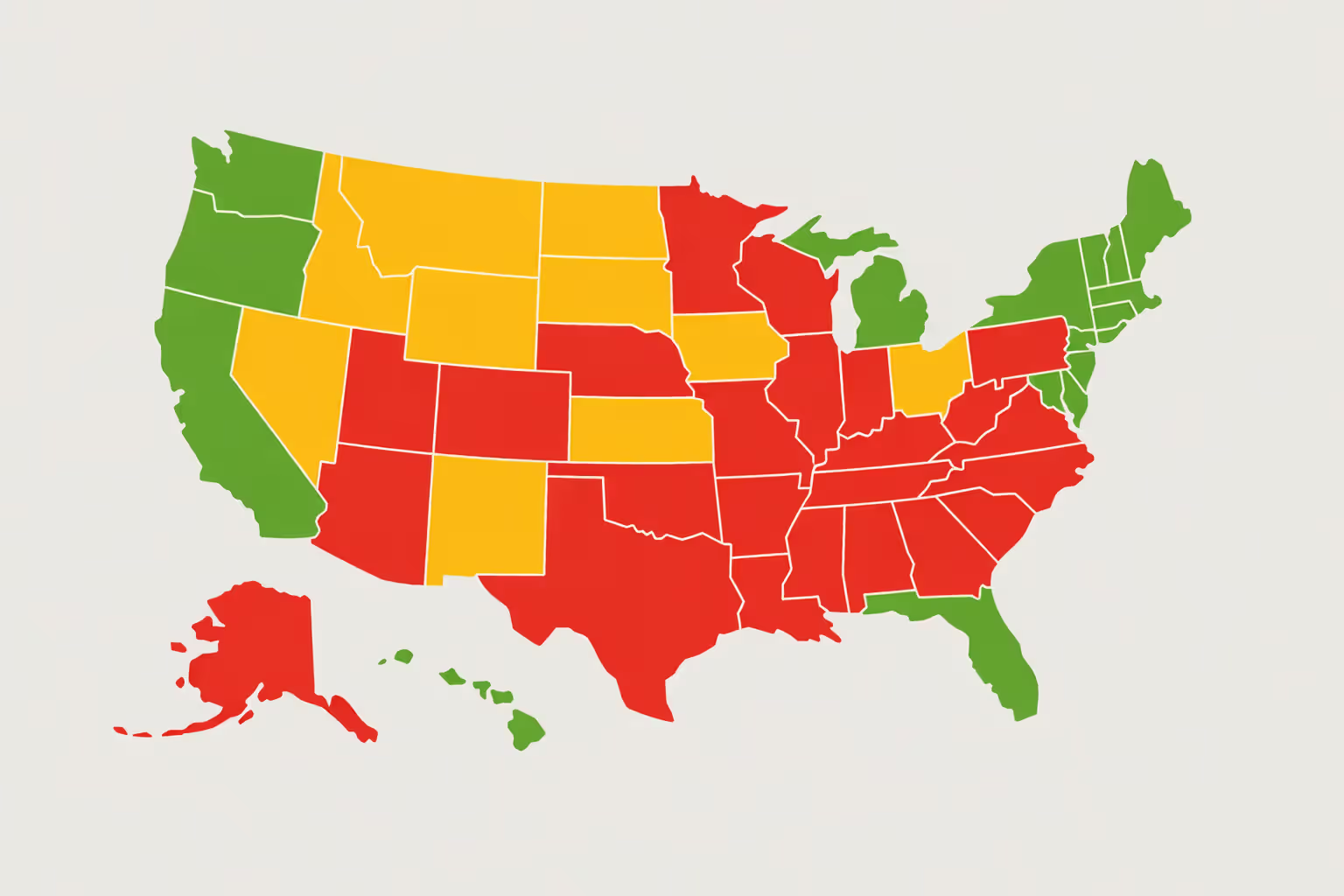
States that prohibit or severely limit these awards: Nebraska, Louisiana, and Washington essentially prohibit punitive damages in most cases. Massachusetts restricts them to specific statutory violations. A catastrophic crash in Louisiana might generate $6 million in compensatory damages for medical care and lost earnings but exactly zero in punitive awards regardless of how outrageous the company's conduct. Michigan allows punishment only in specific circumstances like drunk driving causing death, excluding most trucking scenarios.
States with statutory dollar caps: Texas imposes a complex cap: the greater of $200,000 OR two times economic damages plus non-economic damages capped at $750,000. Here's how that plays out: If you have $600,000 in medical bills and lost wages (economic damages) plus $600,000 for pain and suffering (non-economic damages), the maximum punitive award is $1.95 million—calculated as (2 × $600,000) + $750,000. Colorado restricts punitive awards to match compensatory damages exactly, creating a 1:1 maximum ratio. In Florida, punitive damages max out at three times compensatory damages or $500,000, whichever is greater—unless the defendant showed specific intent to harm, which removes the cap.
States with minimal or no restrictions: California, New York, Illinois, and Pennsylvania impose no statutory caps on punitive damages for trucking cases. Awards depend entirely on jury discretion guided only by constitutional reasonableness standards. Georgia nominally caps punitive damages at $250,000 BUT excludes product liability, DUI cases, and situations involving specific intent to harm—exceptions that often apply in egregious trucking litigation, effectively removing the cap in serious cases.
Split-recovery jurisdictions: Georgia, Missouri, Illinois, Indiana, Iowa, and Utah require defendants to pay portions of punitive awards directly to state treasuries rather than entirely to plaintiffs. Georgia's statute mandates 75% of punitive damages (after deducting attorney fees and costs) go to the state. This doesn't reduce punishment to defendants—they still write the full check—but it dramatically affects plaintiff recovery calculations and settlement dynamics.
Federal jurisdiction complications: Many trucking accidents involve interstate commerce, allowing cases to be filed in federal court. Federal courts sitting in diversity jurisdiction apply the punitive damage laws of their state, so state law still governs. Forum selection remains critical even in federal cases.
These dramatic variations create strategic decisions. A strong case might be worth pursuing aggressively in Illinois with no cap, but the same case might not justify litigation costs in Texas with its strict formula. Attorneys analyze whether accident location, corporate headquarters location, or other factors allow choosing more favorable jurisdictions.
Reckless driving penalties trucking companies face through civil punitive damages routinely exceed federal regulatory fines by 100-fold or more, making jurisdiction selection financially critical for both sides.
Author: Marcus Delaney;
Source: capeverde-vip.com
How to Prove Your Trucking Case Qualifies for Punitive Damages
Establishing entitlement to punitive damages requires investigation beyond typical accident cases. You're not just proving causation and harm—you're proving the defendant's conduct was so reprehensible it deserves financial punishment.
Targeting corporate knowledge through discovery: The evidence you need lives in corporate email servers, policy manuals, and internal communications. You issue document requests demanding: - Complete communications regarding the specific driver involved, including prior complaints or incidents - Corporate safety policies and all revisions made in the five years preceding the crash - Records from FMCSA audits, compliance reviews, violation notices, and any corrective action plans - Budget documents showing allocations for maintenance, safety training, and compliance programs - Minutes from executive and board meetings discussing safety, compliance costs, or risk management - Compensation structures for drivers, dispatchers, and operations managers—looking for incentives that reward speed over safety - Insurance loss runs showing prior similar incidents
The goal? Find documentary proof that management knew about dangers and ignored them.
Punitive damages in trucking cases are not about one accident — they are about revealing a pattern of corporate decision-making that systematically prioritized profit over the lives of everyone sharing the road. The documents we uncover in discovery tell the real story of how these tragedies were not just foreseeable but foreseen.
— Lisa A. Blue
Telematics and electronic data: Modern commercial trucks generate extensive electronic evidence. Electronic logging devices track actual driving hours with precision. Telematics systems record speed, hard braking events, rapid acceleration, seatbelt usage, and other driver behaviors. When this electronic data contradicts official logbooks or reveals patterns of violations, it provides irrefutable evidence of systematic non-compliance.
Expert witness requirements: You need industry experts who can explain how the defendant's conduct departed from accepted standards. Trucking safety consultants review maintenance practices, hiring procedures, and training programs, then testify whether they meet federal regulations and industry norms. Former FMCSA enforcement officials make particularly credible experts—they've seen thousands of operations and can articulate exactly how this defendant's practices fall short.
Economic experts become necessary for calculating appropriate punitive amounts. They analyze corporate financials, compare to industry peers, and recommend award levels that will actually affect corporate behavior without destroying the company.
Deposing drivers and supervisors: The driver who caused your crash often becomes a cooperative witness once they realize they face personal liability. Questions focus on training adequacy, corporate messages about priorities, and whether they felt pressured to cut corners. Many drivers, when deposed, describe unwritten company policies: "Everyone knew dispatch expected us to make delivery windows even if it meant fudging the logs" or "maintenance requests got ignored for weeks unless a truck literally wouldn't start."
Pattern and practice evidence: Courts often permit evidence of similar prior incidents to prove the conduct wasn't isolated. If a carrier had seven accidents in three years involving fatigued drivers exceeding hours-of-service limits, that pattern suggests systematic problems rather than one driver's poor judgment. This evidence might be excluded during the liability phase but becomes highly relevant when arguing corporate conduct warrants punishment.
Corporate representative depositions: Federal rules let you depose a corporate representative on designated topics. You specify topics like "policies regarding driver hours-of-service compliance" or "procedures for addressing maintenance violations," and the company must produce someone knowledgeable. These depositions often reveal gaps between written policies and actual practices—or expose startling ignorance at management levels about critical safety issues. Both scenarios strengthen punitive claims.
Financial discovery becomes critical: Once you establish conduct deserving punishment, you need financial information to argue for appropriate amounts. Companies fight this discovery aggressively, arguing their finances aren't relevant. Courts typically permit it once you make a threshold showing of punishable conduct. Tax returns, balance sheets, profit and loss statements, asset valuations, and executive compensation all become discoverable. You need this to help juries calibrate awards that will actually deter—not just annoy—corporate defendants.
Timeline expectations matter: Punitive damage cases take significantly longer than standard negligence claims because of additional discovery requirements. Budget 24 to 40 months from filing to trial in complex trucking cases with punitive claims, compared to 12 to 20 months for straightforward compensatory-only cases. The extra time comes from fighting over corporate document production, conducting multiple expert depositions, and briefing complex legal issues about punitive damage standards.
Frequently Asked Questions
Punitive damages represent the civil justice system's strongest tool for addressing corporate misconduct that places profits over human lives. In the trucking context, these awards target the systematic failures and deliberate corner-cutting that transform commercial vehicles into instruments of death and serious injury.
While the legal threshold remains appropriately high—courts don't punish every mistake—cases involving falsified records, ignored maintenance defects, coerced regulatory violations, or knowing deployment of dangerous drivers regularly clear that bar. The financial stakes justify the additional complexity and litigation costs. A case worth $2 million in compensatory damages might generate $8 million to $12 million with punitive awards, fundamentally changing outcomes for both plaintiffs and defendants.
These awards serve purposes beyond individual compensation. They force industry-wide improvements by making dangerous practices economically unsustainable. When a major carrier faces a $25 million punitive award for systematic hours-of-service violations, every trucking company notices. Compliance becomes cheaper than gambling with lives.
Success requires early case evaluation to spot potential punitive claims, aggressive discovery targeting corporate knowledge and policies, and expert testimony establishing how dramatically the defendant's conduct departed from industry standards. The jurisdiction where you file can matter as much as the underlying facts, given dramatic state-by-state variations in caps, restrictions, and legal standards.
If you've been injured in a truck accident involving suspicious circumstances—excessive driver hours, inadequately maintained equipment, a carrier with repeated violations, or evidence of falsified records—consult an attorney experienced specifically in punitive damage litigation. The difference between a standard negligence case and one warranting punishment can mean millions in additional recovery and, more importantly, prevent the same corporate indifference from destroying other families.
Don't evaluate your case based solely on medical bills and lost paychecks. Look deeper at the company's conduct. Sometimes the real value isn't in what you lost—it's in what punishment the company deserves for gambling with lives.